
This website will soon end. Please update your bookmarks with the new website address

https://euraf.net/

What is Open Access?

Open Access is the immediateonlinefree availability of research outputs without restrictions on use commonly imposed by publisher copyright agreements. Open Access includes the outputs that scholars normally give away for free for publication; it includes peer-reviewed journal articles, conference papers and datasets of various kinds.

What are repositories?

An Open Access repository is a database or a virtual archive established to collect, disseminate and preserve scientific output like scientific articles and datasets and make them freely available. The action of depositing material in a repository is (self)archiving. Depending on personal preferences or publisher's policies, the author can make his work available in Open Access or (temporarily) restrict the access to it.

Repositories can be either linked to an institution or department or linked to a research field or subject, i.e. Institutional or Subject Repositories.

What is 'Open Research Data'?

Research data can be extremely diverse: from spreadsheets, audio-visual materials, databases, to 3D-models and result lists from large experiments. Sizes may vary from a couple of small files related to a specific publication (‘long tail of research data’) to vast collections of experimental results (‘big data’), that can only be processed using specialized programmes. 

What is an Open Access Journal?

One way of providing Open Access is to publish in an Open Access Journal. These journals make their articles available for free by funding their publication services in other ways than through end-user subscriptions. A lot of journals fund their workings by charging Article Processing Charges (APCs), although not all publishers do and there exist huge variations in the actual amount of the APC.

Primera reunión de la RAIN gallega

El 12 de septiembre se celebró en Lugo la primera reunión de la Red Regional de Innovación Agroforestal de Galicia. Casi 30 participantes acudieron al evento, entre los que se encontraban agricultores, ganaderos, asesores, técnicos de Desarrollo Rural de la Xunta de Galicia, GAIN y responsables de la Oficina Galega de Cambio Climático. La reunión tuvo lugar en el Centro de  Apoyo Científico-Técnico del Campus Terra, sede de la Universidad de Santiago de Compostela en Lugo.

Spanish

What is the role of trees and woodland on an upland livestock farm today? UK RAIN workshop

Trees and woodland can present new opportunities for upland farmers to increase livestock wellbeing and contribute to the profitability of the farm, a role increasingly recognised. However, there are still many questions about the practicalities of how to successfully integrate trees and woodland into farming systems.

English

Combining trees and vegetable production: UK RAIN workshop

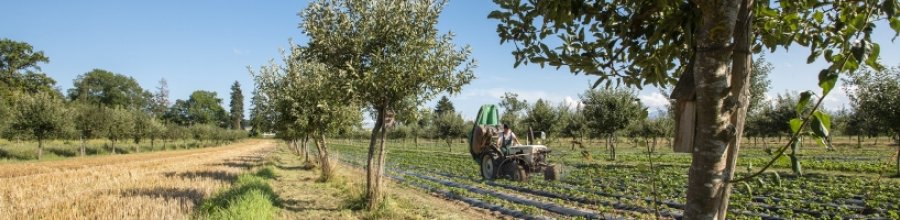
Integrating trees into horticultural systems offers opportunities to diversify the business as well as realise environmental benefits. This workshop took place on 19th September at Tolhurst Organic was organised by the Organic Research Centre as part of the AFINET and AGFORWARD projects focused on providing practical advice and pointers on how to successfully implement an agroforestry system on your farm as well as an opportunity to learn directly from Ian Tolhurst’s (Tolly) experiences.

English